
For at least 20 years, I’ve had an account on LinkedIn. Thanks to the platform, I have met many interesting people, found business opportunities and learned a lot about career, entrepreneurship and business management in general. As a user, I connected with almost 2,000 people, posted articles, have initiated groups and paid for advertising to promote my business initiatives. LinkedIn has been a great online tool in augmenting my business life.
Let’s connect
In the early years, it became a sport for me to connect. I asked anyone I met to connect with me in LinkedIn, just to boost my number of connections. Attending networking events basically meant another opportunity to harvest new contacts. I do remember breaking through the magic ceiling of 500 connections. If I remember correctly, by doing so I unlocked some new featutes or functionalities. Whatever it was, it felt good. The fact that I hardly knew many of my online connections was irrelevant to me at the time.
Later, I started receiving connection invitations from unknown people of whom I had absolutely no shared experience, knowledge, interests or connections with. I couldn’t figure out how these people found me and why there were interested in me. Were these just interested to get access to my network? Or was there something more sinister going on? At any rate, I decided that quality was better than quantity and only connected with people I had at least a proper conversation with. I continued to be an avid yet more conscious user.
What is there to like?
Online, social equity is often expressed in number of ‘likes’. I have always pondered over the question: “What does a ‘like’ on a social media post actually mean?”
For me it differs wildly. I could like someone’s opinion, because I agree with it. However, I could also like someone’s opinion, not because I agree with him, but because I find it important that his viewpoint is heard. Especially in heavily entrenched polarized discussions, I celebrate perspectives that shift the focus, even if I disagree.
Also, I could like a post because the person is very dear to me and know that self-expression is a big step for him or her. Do I agree with the post? Not necessarily. Or someone shares a business success. I can be happy for the individual, although I might also think the success or the organization behind it are quite destructive to mankind.
Not feeling the need to express my rationale behind my likes, I continued liking posts on LinkedIn.
Strictly business?
Over the years I noticed a gradual change (evolution, or devolution if you will) in the content that passed my feed. In my experience, where LinkedIn started off as a website for strictly business networking, it became a forum that, at least in part, competed with the social media outlets of Facebook, Google, Twitter and others. Linkedin changed into a meeting place where users also shared their day-to-day non-business acitivities, personal development stories and content for (self-)promotion. Later, I believe since the paradigm shifting year of 2020, it also became a ground for political discourse, activism and virtue signaling.
Growing concerns
For business promotion, but also out of sheer curiosity, I had become a lot more knowledgable on a broad variety of digital topics: SEO, user analytics, tracking technology, dark patterns, online ad targeting, cross linking data pools, OSINT and many more fancy buzzwords. I realized how much power and control the people working for such platforms had.
Whomever has such technology at his disposal can influence, steer and direct masses into doing whatever you want. To illustrate the dangers of this, especially in combination with AI, I wrote a political thriller in 2021 called “Nothing as it seems“. Parts of it eerily have already become reality today. The novelle is free to download.
These concerns had already led to me stop using all Google and Meta products. These departures were far from easy. Therefore I continued using LinkedIn, albeit more and more concerned.
Breaking the Link
Besides moving away from business-only content, LinkedIn started doing something that worried me a lot. It suggested political figures for me to follow. I ignored it, but the suggestions were very persistent. It wasn’t shown as an advertisement, but likely was a feature that political parties paid for.
Similar to my musings about ‘likes’, I wondered what it means to LinkedIn If I were to follow this politician? Will LinkedIn interpret this as an endorsement of an electoral party?
Then someone reminded me that LinkedIn was owned by Microsoft. It all connected. On one hand is LinkedIn actively pushing political discourse on its platform and on the other hand is Microsoft is continuing to increase its digital surveillance capacity. This very dangerous combination is not a privacy breach; it is an intelligence operation.
Furthermore, if you merge all this data with that of other Big Tech platforms, add AI bots and algorithms to the equation and an almost totalitarian digital power structure is created. This is not fanciful thinking, this is already a reality. Such concentrated power is extremely dangerous and should not be in the hands of any individual or any entity, whether it is Microsoft, any other (Big Tech) company, any government or any other organization.
The exit process
As with my departure from all Google and Meta services, I knew I had to leave LinkedIn as well. I expected it to be quite a sacrifice from a business, career and network perspective, but I also see myself as a pioneer. Fortunately, there is a possibility to ‘try it out’.
LinkedIn actually kindly offers you to hibernate your account: you will no longer be able to use LinkedIn and no one will be able to find you there. It is like a complete removal, but with the option to come back, keeping all your connections and data.
I hibernated my account for an entire year. In this period, I encountered several times when I (thought I) needed LinkedIn. Connecting with someone now means exchanging e-mail addresses instead of a LinkedIn Connection Invite. Did I miss business opportunities? Probably, but… what you don’t know you don’t miss.
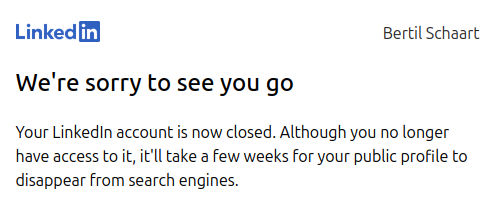
A year later, I reactivated my account, downloaded all my personal data (something you should do always do, even if you stay on social media platforms) and proceeded with the actual deletion of my account and data.
Are there alternatives?
Unfortunately, the only alternative that I have seen that comes close to LinkedIn is Xing (xing.com). It is popular in Germany. I do not have an account there and cannot say if it is a good replacement for LinkedIn. I do know that the company behind, New Work SE, also runs the Internations platform, a network hub for expats.
Perhaps the better solution is to have a smaller circle of friends and acquintances and meet up with them regurlarly.
Is this for you?
Do I recommend doing the same? Ideally yes. But I fully understand that not everyone is willing to pay the price of not being LinkedIn connected online. There, I suggest to try it out. Hibernation is certainly a possibility, but it can also be as easy as deciding not to use the platform for a certain period. Can you do with less?